
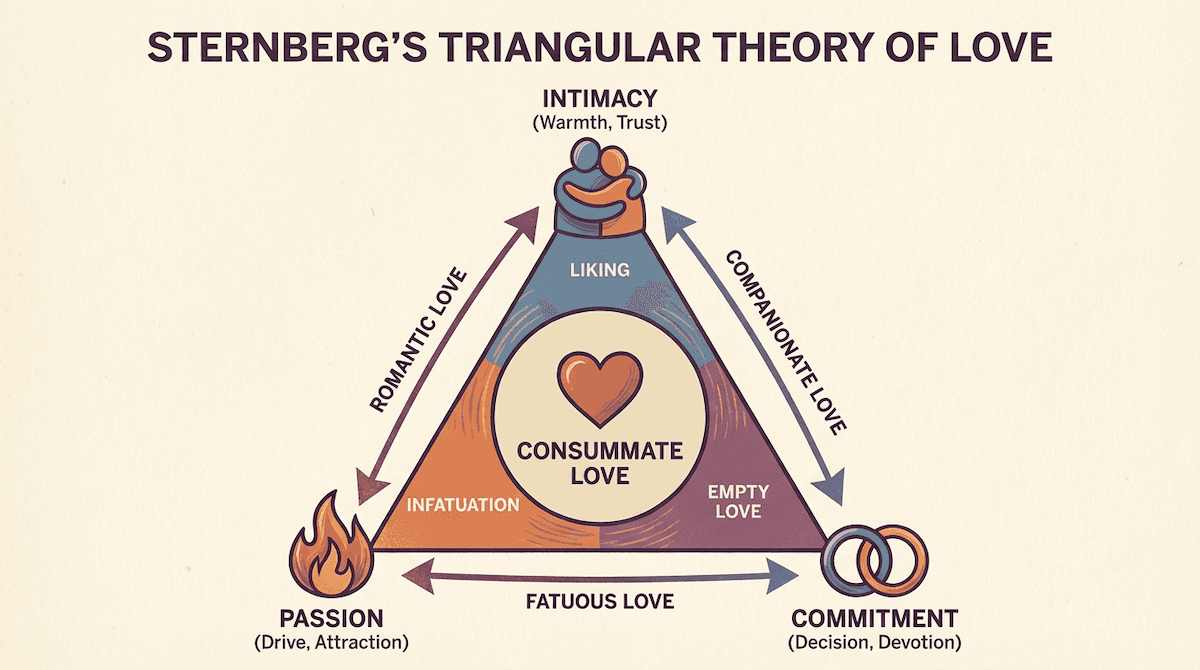
The triangle theory of love posits that love can be understood as the vertices of a triangle. These three are intimacy, passion, and commitment.
Intimacy refers to feelings of closeness, connection, and attachment. It encompasses feelings that give rise to the experience of warmth in the relationship.
Passion refers to the drives that lead to romance, physical attraction, and sexual satisfaction. Passion encompasses the sources of motivation and other forms of arousal.
The decision/commitment encompasses cognitions involved in making decisions about the existence of a loving relationship and the potential long-term commitment to it.
In general, intimacy can largely stem from the emotional investment in the relationship. Passion largely arises from drives, and the decision/commitment stems primarily from cognitive decision-making.
Intimacy can be seen as a “warm” component, passion as a “hot” component, and the decision/commitment component as a “cold” component.
In close relationships, the feeling of emotional involvement and cognitive commitment appears to be relatively stable, whereas motivations and other stimuli of passion are relatively unstable and come and go in an unpredictable manner.
Partners have a certain degree of control over feelings of intimacy (if one is aware of them), a high degree of control over the decision of involvement, but little over the amount of excitement of the passion.
Partners are usually quite aware of the passion, but awareness of intimacy and decisions can vary greatly. Sometimes partners experience warm feelings of intimacy without being aware of them or without being able to name them.
Similarly, partners are often unsure of how committed someone is to a relationship until people or events put that commitment to the test.